Volume 0, Issue 0

Archive for 2012|Yearly archive page

Beware the Curse

In Discussion on 2012/09/15 at 1:08 pm

curse tablet: EyguièresGo ahead. Let it out. You’ll feel better.

One of the places where human justice falls down is the belief, embedded in every story we tell our children from their earliest days, that bad things inevitably happen to people who are bad and that good behavior is rewarded. I’d go so far as to say that the recognition of the failure of that axiom is the source of every crisis of faith ever experienced. The innocent starve. The wicked get wealthy by cheating and stealing. Natural disasters take lives indiscriminately. We believe this unsupportable notion of the inherent fairness of the universe so strongly that when we see evidence strongly to the contrary, it is literally intolerable. We feel it as pain.

We demand justice — or we sink into depression, because all actions are futile and the results of those actions are arbitrary. Read the rest of this entry »


One of Many Problems with Religion

In Discussion on 2012/08/25 at 2:02 pm

Octopus uses empty shells to hide, Wikimedia Commons/Nick HobgoodThis isn’t a problem with all religions, mind. In fact, it’s only a problem with a handful. However, it’s a problem with the most popular, and the most violent — and, anthropologically speaking, the most recent. And this is the problem concept: that humans are special, are blessed, are chosen to be God’s favored children, are somehow above the animals and plants and everything else that lives, and have a God-given right of power over life and death with respect to them.

I’m not sure how all of that made it into the dominant narratives, because much of the scripture it’s based on stops well short of the worst of that in wording. But religions are made out of a huge body of traditions that, in those that do have scriptures, have very little support in those scriptures. Read the rest of this entry »

The Trouble with Science

In Discussion on 2012/08/13 at 9:42 am

R136 stellar nursery, Hubble Space Telescope, 2009We look up in the sky and see ten thousand points of light (give or take a few orders of magnitude depending on location and light pollution) and then, because knowing where the stars are in the sky helps us pinpoint where we are in the seasons despite the vagaries of the weather, we draw lines around them and connecting them and give the drawings names. And we make up stories about the drawings so that we can remember them, and remember that the positions of the stars are important, and, if we’re clever enough with the stories, why.

That’s “why the positions of the stars are important to us”, not any bigger sort of why, like “why are stars the things that are important”. Certainly not a “what”, like “what are stars”. Nor a “how”, as in “how do the positions of the stars drive the planting and harvest cycles”.

Well, that’s not true. The stories can actually address such things. It’s just that when they do, the risk of bullshit is dangerously high. Read the rest of this entry »
An excerpt from “Orange” – Following the Early Risers, part 1

In Fiction on 2012/08/01 at 9:55 am

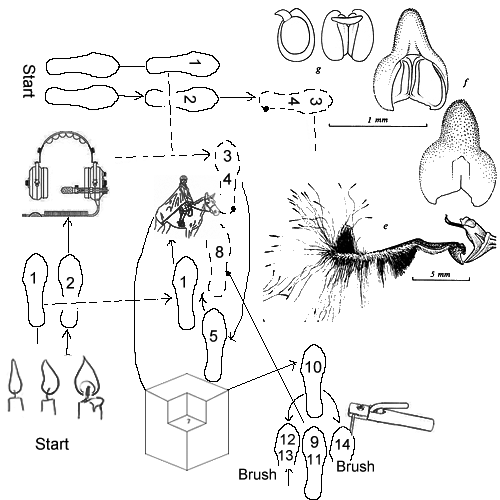
honeybeeHere’s a sample of the hoodoo at work, illustrated in a fragment of my fiction.


©2012 Laszlo Xalieri, from an unpublished work. Used by permission.


At my uncle’s distillery, I adjust the coiled-copper tubing, being careful not to crimp it or crack it. The mash I have already boiled and allowed to cool, have already dumped in some of my uncle’s pet yeast–the eukaryatids that support his favorite vices–and have made sure that the community of little pillars have had plenty of grist to grind and plenty of time to work. The fire is banked but kept warm, and the early and eager spirits collect in waiting columns, ascension prevented. This is a family secret, these waiting columns. You need to catch the early risers.

The sabers I have lashed together, edge to edge, point to hilt. Read the rest of this entry »

The Art of Sacrifice

In Discussion on 2012/07/30 at 9:55 am

Suicide Bomber vest at ComicCon 2007, San Diego, CA, by Cory_DoctorowThe man who is prepared to die may accomplish anything.

I’ve been looking through sources to see who I might be quoting for the sentiment above and I still haven’t sorted it. The original could be in a language I don’t know, thousands of years old. Or maybe it’s a James Bond villain. But it’s not just a truth in narrative logic. It’s actually true. One who dies in the process or aftermath of achieving any goal, no matter how stupid or heinous or heroic or pointless that goal is, is freed from suffering any consequences except the one that he or she has chosen. Any punishment or shame or notoriety passes, usually harmlessly, to family or associates. Both heroes and villains, which are frequently interchangeable depending on individual sympathies, derive their status as such by not being particularly opposed to a fatal outcome.

On that topic, these creatures have something interesting in common: Read the rest of this entry »

More on Narrative Logic

In Discussion on 2012/07/27 at 12:08 pm

steps, in detailOne of tenets of narrative logic — the logic used to make things true in our heads, that causes distress when it does not agree with observations — is that effort is rewarded, followed swiftly by a corollary that says greater effort is rewarded more than lesser effort. Of all the major disagreements with the nature of causality that we carry around in our heads, this one is the one that seems to cause the most misery. We desperately want there to be parity between effort spent and reward received, if not a slight tip of the balance in our favor.

Physical causality isn’t like that. An action taken at the right place in the right time under the right circumstances has a result, and it might be a desired one, but it’s just the next step in a cascade. Read the rest of this entry »

Working in Progress

In Art on 2012/07/23 at 9:38 am

Wishing Well (in progress) by Saia RomanisaelThe works in progress featured in this article are by Saia Romanisael, whom I have never to date met in person but consider to be a close friend. I include her striking pieces here less to accuse her of sorcery than to visually highlight her use of deep-textured elements of symbology and association that would make for good hoodoo workings. Should she be so inclined.

So much of what we think of as the syncretic hodge-podge of homebrew magical action is about a thousand percent tied up in the artistic process, and that fascinates me. We work in symbols and arrange them, in whatever media, according to a logic that has nothing to do with linearity and traditional causal logic. Read the rest of this entry »
John the Balladeer

In Fiction on 2012/07/17 at 10:14 am

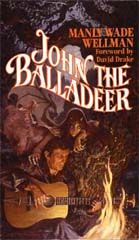
John the Balladeer by Manly Wade WellmanMost of a hundred years ago an author named Manly Wade Wellman wrote for the pulp serials, churning out SF for the juvenile market. And then he turned his hand to things a bit more of a fantastic nature, geared toward a more mature market, and exploded. He invented a character to make central to his tales, set in Appalachian country, and wove a coherent tapestry of the supernatural that still stands to this day.

If you’re a modern consumer of pop culture horror, and have heard of DC/Vertigo Comics’ John Constantine of Hellblazer or Jim Butcher’s Harry Dresden of the Dresden Files, then read a sample below to see the silver-cast prototype of the distinctly North American supernatural troubleshooter. Read the rest of this entry »

On Narrative Causality

In Discussion on 2012/07/16 at 1:36 pm

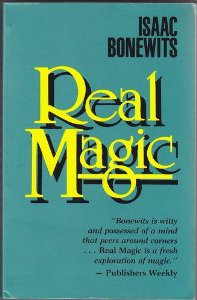
It’s been ages since I’ve read Isaac Bonewits’s Real Magic, but a huge chunk of it stuck with me.

It’s by no means a how-to. Instead, it’s a book-length, thrice-revised expansion of of the senior thesis of the only person I’ve even heard of to receive a Bachelors of the Arts in Thaumaturgy from an accredited university — though it may explain it a bit to say it was from UC Berkeley in 1970. The overall view is that it is an academic work, in construction if not tone and lack of bias, and as such the analysis it contains is not unscientific. Various traditions and practices of (scientifically speaking) a superstitious nature are deconstructed to reveal a candidate set of underlying laws that seem to govern the construction of esoteric belief and ritual.

I remain fascinated by Bonewits’s analysis, and I believe there is some truth in it — truth in what it reveals of how people think why they try to influence the world around them, leaving aside any question of whether such influences are effective. Read the rest of this entry »
A word of welcome…

In Administrative on 2012/07/15 at 2:54 pm

Manitou PetroglyphThe Journal of American Hoodoo exists to identify and explore the different approaches to causality and the unseen world in which we all have been immersed since birth — that portion which remains outside the circle of firelight cast by scientific analysis and accepted facts. Read the rest of this entry »